Discover More About Ongoing Projects with the New Live Storymap

Earlier this month, the Essex Rivers Hub Storymap officially went live and is now ready for viewing and using by both catchment partners and members of the public. This innovative resource acts as a significant tool in not only providing key data across the whole CaBA Catchment Partnership Area, but also transparency and clarity to the public.

The CaBA is a collaborative working approach, considering all aspects and individuals affected to deliver a range of environmental, social and economic benefits to protect our water environments by working at a river catchment scale in its entirety. Considering rivers from their sources to the sea, it allows us to contribute more efficiently towards creating a healthy water environment for the benefit of us all.

This new Storymap is an incredibly useful and dynamic tool that collates all aspects of relevant data into a single integrated resource. The different maps of data are easy to explore, providing geographic context to broaden the reader’s perspective and allowing all users, whether partner or public, to engage directly with the mapped data and the contextual information provided.

Some examples of the data able to be viewed using this resource includes floodplains, underlying geology, land use, habitat quality assessments, barriers to fish migration, storm overflows and more.


How to view the Storymap

For those interested in exploring this new live resource, click here to view the Essex Rivers Hub Storymap. This resource provides a wealth of data across the entire Essex Combined Management Catchment. It is easy to navigate from the first page detailing the Essex Rivers Hub Vision and Aims to the final page on Essex Rivers Hub Monitoring with all data and key information in contained within one accessible resource. Simply click through the five stories to explore everything this new resource has to offer.

Natural Flood Management and Nature-based Solutions projects can be viewed under the Essex Rivers Hub Action page. Since future projects can be added and current projects continuously updated, the most up-to date information will always be available for partners and the public to interact with as it becomes further populated with projects in the region.
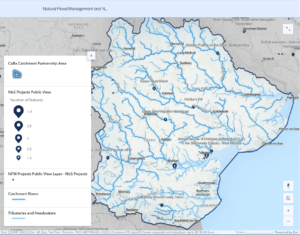
Discover More About Ongoing Projects with the New Live Storymap | Essex Rivers Hub


Insightful data is also available on the Essex Rivers Hub Monitoring page, highlighting all current water quality monitoring undertaken by Essex RiverWatch citizen scientists. It will also be exciting to watch as this map resource continues to fill up as we get closer to achieving our aim of engaging 100 citizen scientists by 2026 (Our Catchment Plan to 2030: Aim 2, objective c).
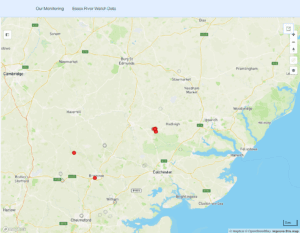
Discover More About Ongoing Projects with the New Live Storymap | Essex Rivers Hub


Being able to explore the character of the rivers and their tributaries within the catchment area delivers the holistic view of the Catchment Based Approach, embedding collaborative working at a river catchment scale that maintains a transparent communication between other partners and the public. By staying informed about the latest updates in ongoing projects, the public are able to play their role in advocating for future action and hold water companies and local politicians accountable for their environmental responsibilities.


Click here to view the Essex Rivers Hub Storymap
Get Involved Today

Find out about the latest volunteer opportunities and explore our hub of resources.

Related Stories

Pressures

The topics below represent the pressures that many waterbodies in the Combined Essex catchment face. They have been divided into six main categories, but it is quite often that these categories can overlap as pressures relate to each other.

Diffuse Pollution

Diffuse pollution occurs as water moves across the land or through the ground and picks pollutants. These pollutants can come from a variety of places, including urban and field run off. The pollutants that enter the river can range from sediment to toxins to excess nutrients, meaning that diffuse pollution can cause a whole range of different issues. The variety in these pressure groups means that it is something that can be quite difficult to tackle. It requires groups of people, business and stakeholders to work together in order to solve this problem.

Fish Passage

Fish should be able to travel up and down a river freely, allowing them to move and breed in the most suitable habitats for them. It is important that fish populations do not become isolated, as this makes them more susceptible to disease and puts pressure on their survival. Unfortunately, there are often many barriers along rivers that prevent fish from being able to migrate up and down stream. Where barriers have been identified, they will be seen as a ‘pressure’ on a waterbody. Thankfully, there are many solutions now that can be put in place to aid fish passage, even over large barriers.

Flow

The flow in a river can vary greatly throughout the year as rainfall and run off can have an effect. This is a natural process. It is when flow is impacted by non-natural processes that it can cause problems. Sometimes, water can be intercepted or removed from a system; this will reduce the flow, therefore changing the habitat conditions. Some species are happy in high energy rivers. This means that when flow is reduced, these species will no longer survive. The opposite of this can occur when excess water is entering a river, for example through increased runoff. Low energy systems then become high energy and displace the species that live there.

Invasive Species

A species that is not meant to be found in a particular area is known as an invasive species. Invasive species can be from a different habitat or a different country altogether. Most of the invasive species that we find on our rivers have come from other countries – plants that people have imported for their gardens or animals that have been released for food or by animal rights activists. Control of invasive species requires a lot of time and effort. We are fortunate that we do have a range of methods to manage most of the invasive species that cause havoc on our rivers, but there are still some which we are still struggling to control.

Physical Modification

Many of our rivers have been heavily modified over the years as rivers have been used for a wide range of purposes. Physical modification is one of the biggest factors that causes our rivers to be unhealthy. The issues that it can cause range from reducing habitat, preventing migration of mobile species, and even have an effect on the water quality. Where structures and modifications are no longer in use or necessary, they should be removed to allow the river to regain its natural state. Unfortunately, this action is not always taken which means that many of our rivers are over straightened and contain redundant structures. It is possible to return a lot of our rivers to their natural state, through one off projects, but in other cases it is not possible as the river has been changed to protect assets or manage flooding. It is recognised that some modifications cannot be removed without having severe negative impacts both socially and economically.

Point Source

This is pollution that comes from a single identifiable source. The pollution entering the river could include a whole range of pollutants. Some point source pollution is known about and licences, for example sewage treatment works. Other sources are not licensed, and therefore work needs to be done with landowners to fix the problems that are allowing the pollution to enter the river. Point source pollution is more easily controlled than diffuse pollution as it often only takes one management approach to solve the issue.